

TOWARD THE NEW PHENOMENA
Beeple Studios' Regular Animals

So, we’ve done it now.
Art History, or a Aesthetics of Schizophrenia
By now, I think we can all understand that Art Basel Miami Beach is not so much a serious affair but a provocative election of the art world’s most absurd, ironic, or outrage-inducing visual-comedians. Speaking of such, we all remember last year’s Comedian, Maurizio Cattelan’s banana-on-wall installation that would later famously sell for $6 million at Sotheby’s Hong Kong. This happens nearly every year with even the art-lovers in the know making a joke that ABMB is less about showcasing the rising stars of Contemporary Art and more-so a lightning rod for strangeness that is only barely socially acceptable. Allegations that Modern and Contemporary Art are fleecing, money-laundering vehicles dressed up in galleries as conceptual exercises are not only encouraged, they are the whole point.
This fair in particular has been interesting because, just two months before opening, a number of famous Blue Chip galleries decided to drop. This made room for new galleries to buy their way into the Art Basel extended-universe with the risk of either making a splash or going unnoticed. There were some big shoes to fill this year, and, well, Beeple Studios certainly filled them.
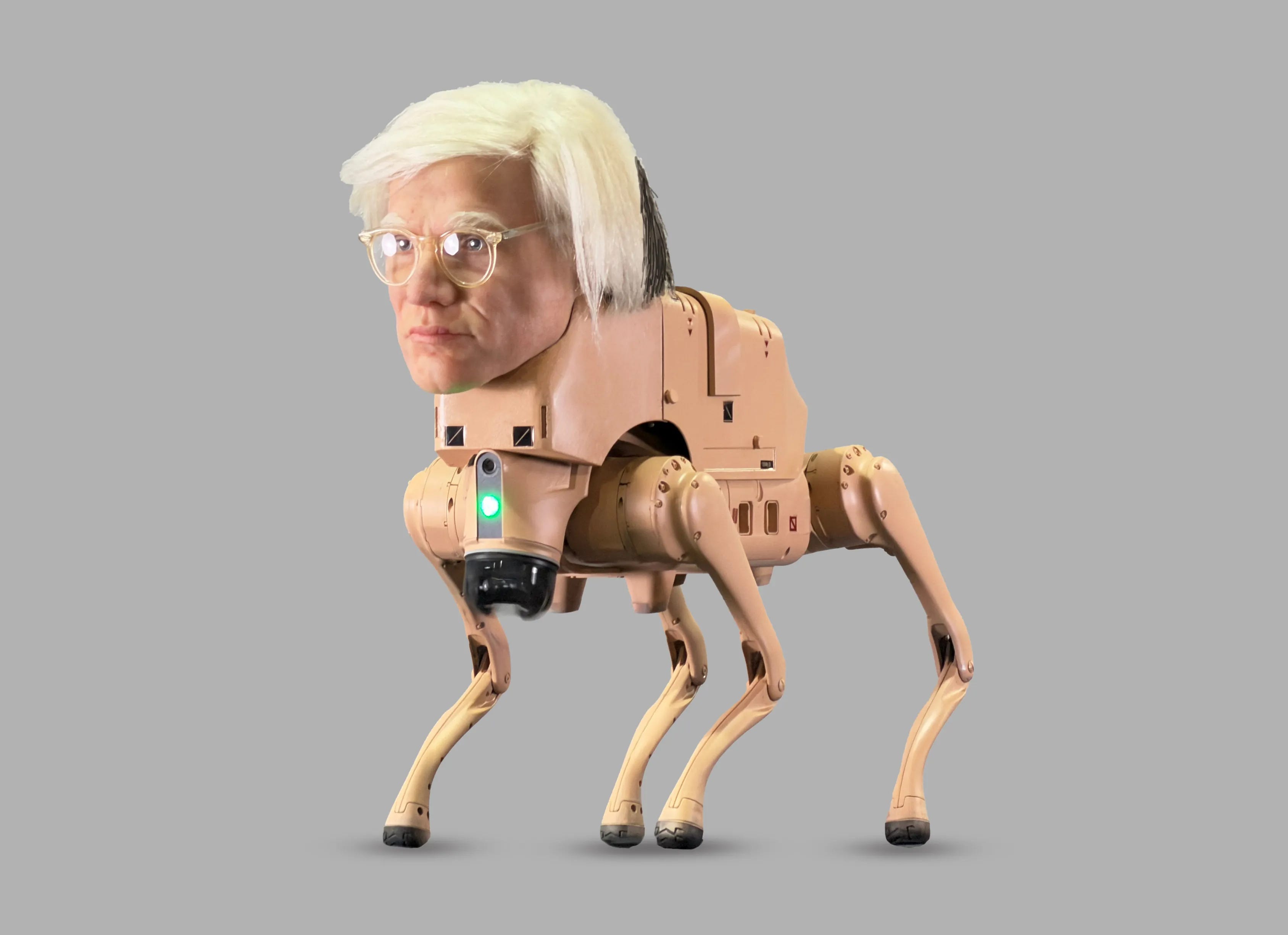
Regular Animals is an installation from Beeple Studios of five quadrupedal robots (fashioned loosely in the style of the viral Spot robot ‘dog’ designed by Boston Dynamics), that have been topped with the hyperrealistic sculptured heads of some of the world’s most infamous faces, post political and artistic. Behold: Elon Musk, Mark Zuckerberg, Andy Warhol, Pablo Picasso, and even the artist, Beeple, himself. The robots are colored in tan, fleshy hues and move about in mysteriously insectoid jerks. It is the essence of bizarre science fiction, and videos of these ‘regular’ creatures “roaming” around in random patterns and “pooping” out photographs have gone viral on Art Basel’s Instagram page. By the end of the fair, which concluded on December 6, they had gained enough attention to even receive an award from the fair, effectively making Regular Animals this year’s poster child for the “I can’t believe we’re calling this art” crowd. It is, to be fair, a step above the “my five year old could do that” review that the typical paintings and sculptures receive in other parts of the fair.
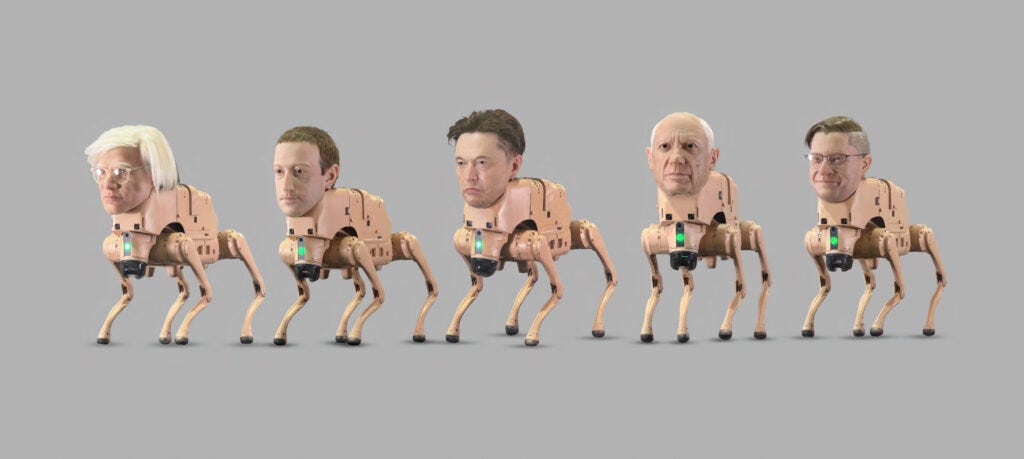
While these robots are the obvious part of the exhibit, there is also a purely visual element. The aforementioned excreted photographs produced by each robot are all entirely unique and harvested by a Beeple attendant to be hung on an adjacent wall. Referred to as the ‘Memories’ of each animal, each of the robots are programmed to produce these photos in accordance with the style and temperament of the personae they imitate. A camera located in the front of the Animal snaps a picture at regular intervals and a computer within the body of the machine filters the picture through an AI preset to make the image look “artistic” before the altered picture is distributed from a posterior printer. Each one is individual. For example, the Picasso-bot is programmed to have a “very high” “artistic output” in a “proto-cubist” style and to move around at a physically “slow” speed. The Elon Musk robot, however, is programmed to move at a “fast” speed and only produce “cognitive blueprint” Memories at a “very low (rare)” rate. Throughout the duration of their installation, around 183 of these Memories were produced in various corresponding styles.
In his artist statement, Beeple referred to Regular Animals as a “ living archive of machine-mediated perception… a meditation on authorship, identity, and autonomy in an age of accelerating AI.” Beeple encourages audiences to view Regular Animals not as machines but as living, innovative forms of consciousness that encounter the world, that hold a sense of embodiment as reckoning agents, “a feedback loop in which the artwork observes, learns, and remembers us in return.” This is not a new concept in art making, but it is a new materialization. For as long as art has existed, we have imagined painted figures as looking outside of their painted worlds in various modes of “address” with the viewer. But now we have tangible proof that there is a work of art that watches us watch it.
In art history, the most famous observer of the watchful painting is Michael Fried. In his seminal Absorption and Theatricality: Art and Beholer in the Age of Diderot, Fried presented 18th century painting through two modes: the absorptive figure who lives in their painted world without notice of the audience, and the theatrical, spectacular figure who seems to have been immaculately placed in a composition specifically to be looked at. Underneath this theory of theatricality, which has informed the whole of Fried’s Modern Art criticism, is the seeming schizophrenic anxiety that a painting is looking at you, doing something purely for your sake. The painting which Fried determines is good is one that skirts this anxiety by not noticing that the figures within are a spectacle. While this interpretation of Fried’s work may seem reductive, it is the core of a certain aesthetic “projection” that he himself has recognized in his criticism.
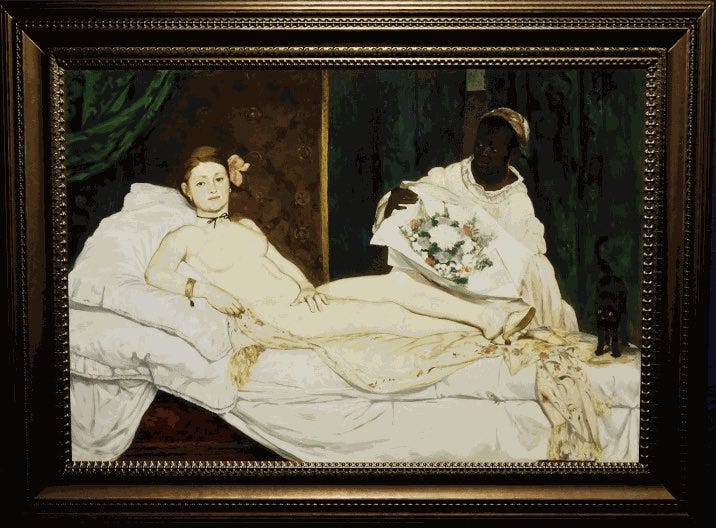
Fried tracks the history of Modern Art as a dialectic of these two concepts, eventually culminating in the all-seeing Olympia of Edouard Manet which defiantly faces the convention of address and theatricality by openly “beholding” us back. The acting concept is that ‘Olympia’ sees us and wonders why we are looking at her – a schizophrenic confrontation – this is her space, her tableau, what are we doing here? Though not using the term ‘theatricality,’ John Berger famously spoke of Olympia in his Ways of Seeing as being the ultimate reckoning that the model painted for your enjoyment knows your motivation and disapproves of you.
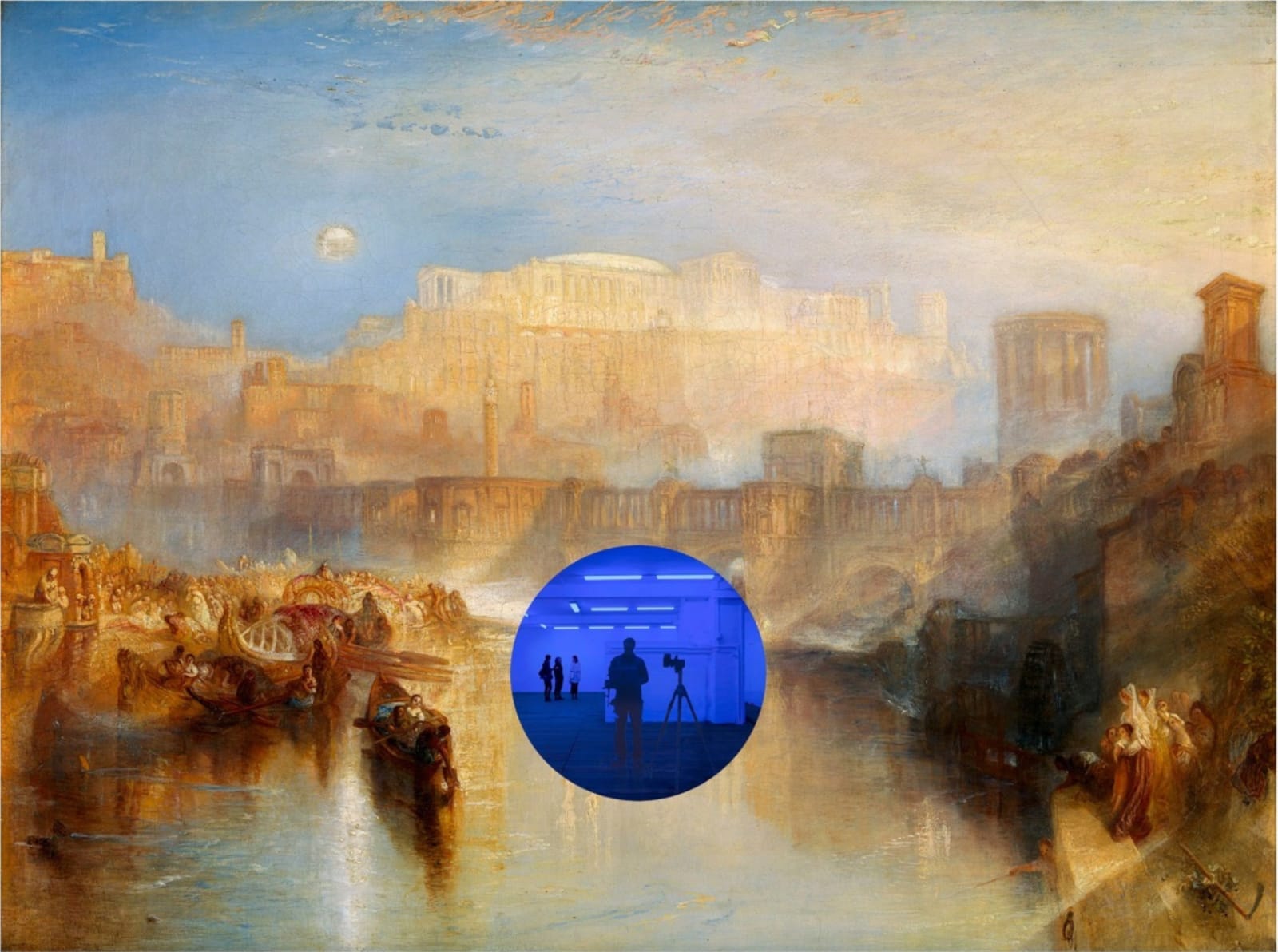
Thus begins the history of the avant-garde. As portraiture and representative painting rests as a concept, this fear for a direct encounter like the one portrayed in Olympia abstracts, but the anxiety never fully sleeps. The artist himself replaces the painted figure as the object to whom we can ‘wrong’ by looking at a painting the wrong way, which Fried and Walter Benn Michaels address in their discussions of Minimalist painting. Some contemporary painters have attempted to address this anxiety fully by including the viewer as part of the art itself. Jeff Koons’s “Gazing Ball Series” implants a mirror directly into the surfaces of famous paintings and sculpture as a way of giving them a pair of artificial ‘eyes.’ The viewer now sees themselves in the artwork as though it is looking back at them and incorporating the beholder into itself.
This is all to say that we have always had this implicit relationship between painting and viewer in which we cannot help but give into a schizophrenic exchange of looking and being looked at. The innovation, the “meditation” of Regular Animals is the certainty of your incorporation into the artwork as part of a more developed, active process of the “artistic” machine. You are seeing it and it is encountering you equally with very real cameras, taking pictures of you, stylizing you, making your own likeness into part of its ever-increasing exhibition, and we call this “seeing.”
The Blind Machine
Can machines see?
There is a much more abstract question within Regular Animals that it is provoking, that being are these Memories created by the robots fit to be viewed as art, but I am going to choose to ignore this question for now. What I want to get at is something more fundamental because if we want to ask this question of ‘is it art or just mere mechanized representation’ we have to first wonder about what the ‘mind’ of the machine is doing when it ‘sees’ – if that mechanism can be called seeing at all in the sense of what we have come to know seeing as.
At face value, it seems pretty simple to understand a metaphysics of ‘seeing.’ Thomas Reid of the Common Sense school of epistemology described simply as simply gathering sense data through your eyes, something which I have no doubt the ancients from which Reid derived his metaphysics would have agreed with. For Plato and Aristotle, there was no question of your eyes fooling you. Your mind could fool you and misinterpret what you see, but to see was to look and to look was to see. It wasn’t until we got to Kant that we understood the act of seeing as something much more than meets the eye, but we will get to that later.
What is important though is that, while this common sense approach is still widely accepted, it is also all but entirely accepted that machines do not see things. At least, not the way humans do. Though they complete a process of something that is like seeing, that may be described very similar to seeing in those Reidian terms, seeing is still a conscious activity and machines are not conscious. What AI does with its visual sensor (notice we cannot call it an eye), is more akin to motion detection than true visual detection, akin to how we look up suddenly when we suddenly detect movement in our peripheral vision. In the case of Regular Animals, the motion element is even simpler. Likely it is able to sense motion in so far as to not run into things – boundaries, or other robots in the enclosure; humans have not been allowed to touch the robots – similar to how an electric car works. At regular intervals, and each depending upon the programming itself, a photograph will be taken of what the Animal would theoretically be “seeing” at that moment based on the location of an implemented camera.
So we have solved one thing. No, it is not seeing as we do. We do not have to worry about it looking at us all of the time in the way we may impress a spooky painting with the phantom idea of it watching us from all angles. But the work is far from finished because Regular Animals is not just a disturbingly dressed up camera and printer, it is a kind of mind, isn’t it?
When each of the Animals takes a picture, it is not immediately printed. As mentioned, the image is processed through Artificial Intelligence and filtered in a specific way in accordance to the style – real or satirized – of the animal’s personality. So it would seem that the next question to be tackled on our list of deductions on the question of a mindful artwork is how the image it takes of us is being processed through said artwork’s “mind.” For the sake of brevity, I will not be making arguments about the supposed sentience or merited autonomy that should be awarded. I will not even be debating the semantics of calling an AI a “mind” as that debate is far outside of my expertise as a critic. How I speak of autonomy in the AI processing engines that make up Regular Animals is done so through understanding the autonomy of the work of art and the way in which I do so is for the sake of, really, not knowing how else to refer to it.
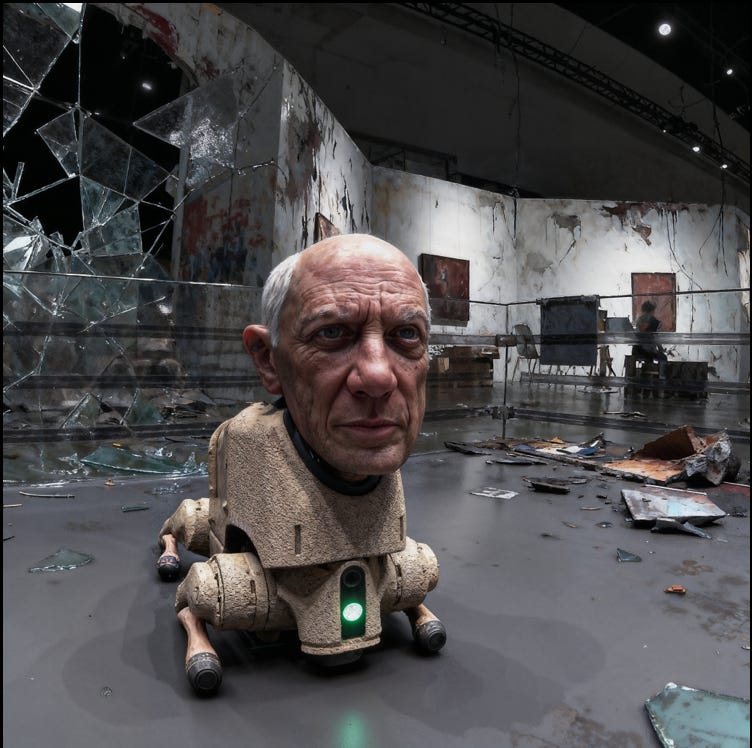
Each of the filtering programs in Regular Animals demonstrates that the AI, in filtering the image, does fully process the contents of said image. Instances of this can be found across all 183 Memories generated by the robots, but I will highlight three examples from three different programs. In Memory 0007, the robot Beeple-AP takes a picture of the face-on Picasso robot that has now been altered to be surrounded by broken glass seemingly caused by a destroyed gallery window to Picasso’s left. This is in accordance with Beeple’s “Dystopic Futurism” filtering, and broken neon signs, debris, cracked walls, and general grime fill the settings of its pictures. This is the most significant example of the AI clearly being proficient in recognizing it’s surroundings. Rather than simply implementing a filter in the way that the Warhol or Picasso robots do – each producing similar results to basic photo-editing presets that have existed long before the advent of AI at this stage — it shows the proper ability to recognize objects so that they may be altered.
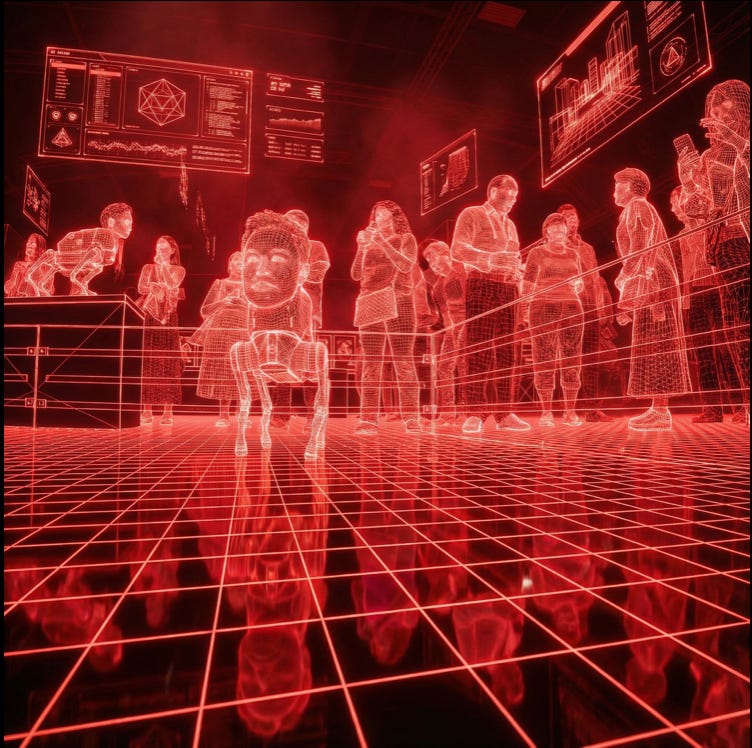
Memory 0026 is one of the Zuck-1 “Metaversal” pictures which are filtered to show optimized depth in tech-savvy neon. Unlike the Beeple pictures, the Zuck pictures are not altered in any way besides the layering of the filter, but we still see the ability of the machine to infer three-dimensional space even on a two-dimension image, likely because it is processing that the shapes in the image are representations of real humans not just human-esque shapes. Memories 0040 and 0042 from the Picasso robot show each of the robots, other than itself and the Warhol which is out of frame, altered to appear exactly as dogs, either omitting their human-ish faces and robotic bodies, or distorting them so much that they are no longer recognizable as the robotic figure that they are supposed to represent. 0040 shows two robots that may or may not be the Elon and Zuck sitting in dog-like postures with dog-like ears. 0042 omits the human face altogether and registers the shape clearly as a dog, though maintains the camera-lens at the front of the canine’s robotic body. This was an error in the processing element of the AI, meaning that it is doing some sort of “thinking,” some “inferring” even if rudimentary.


That being said, the way that it thinks is likely not highly unique from how most AI engines function for other purposes. Programmers on UniteAR (Alternative Reality), explain that in workplace settings, one of the main ones being healthcare, an AI is trained on hundreds and hundreds of images of, for example, brian scans. It is taught what to look for using this visual data, and then when an image is uploaded into the scan imaging software, the AI relies upon the past data collection to infer similarities between this model and the previous, reaching a conclusion. They do this by analyzing the organizations of pixels in the uploaded image, from which they can understand the “textures” of a representation using complex math-based algorithms. The image is, in effect, converted into a series of equations that the computer can understand easier than it can an actual image. An applicable example for Regular Animals would be facial recognition software. Most of the time, the robots are able to “perceive” and differentiate between different human face, mostly those of their fellow robots. This is not because they recognize the face inherently the way a human mind will recognize their mother or lover. It is because, and with high speed and precision, the algorithm can measure the spaces between details in the faces and effectively infer that it is the same face as one that it analyzed previously.
We can see then that robotic vision is much different than human vision and therefore, as I am sure we all already figured, Beeple Studio’s Regular Animals is not a work of art that looks at us, that regards us, in the same way that Michael Fried’s anxiety over theatricality and awareness would permit. That’s just not what it’s like when we look at people.
What is Human Vision?
We have reached the part of the essay wherein I must talk about Kant. I will try to be gentle.
Jules Kristeva says that postmodernism is just a radicalization of Kant, well perhaps, but we’ll be going all the way back to the first pages. The crux of Immanuel Kant’s Critique of Pure Reason is the distinction between the two concepts of reality called phenomena and noumena. Phenomena is easy to describe, at least at onset, because it is the reality which we experience every day. The phenomenal is the perceived, that which is made up of a priori truths and a posteriori conditions. It is the reality of touch and taste and smell. It is the realm of sight and perception – which will become a weighty concept for Kant on its own. It is the realm of concepts themselves.
When you look at something as a human, your eyes are only doing half the work. Your mind supplies in the details of an image, which really may just be arbitrary scribbles or indistinct qualities, with meaning. Symbols on a wall become an exit sign. Numbers on a box become your alarm clock. A particular flower in the garden is yellow, which also means that it is not red or white or purple and it is also relationally composed among other flowers. These are all qualities which are not imbued within the objects themselves but arrive from us looking at them and filling in their reality with our own. Furthermore, even the concepts of time and space are purely human-constructed. Animals have no concept of how many days are in a year or really of their own ages. A book on a shelf does not have a concept of being next to another book, that is only us. As Kant says in “The Transcendental Aesthetic;”
Space does not represent any property of things in themselves, nor does it represent them in their relation to one another; i.e. space does not represent any determination that would adhere to objects themselves and that would remain if we abstracted all subjective conditions from intuition. For no determinations, whether absolute or relative, can be intuited prior to the existence of the things to which they belong, and hence none can be intuited a priori. (B42/A26)
And on the notion of time,
Time is nothing but the form of inner sense, that is of our intuition of ourselves, and of our inner state. Time cannot be a determination of outer appearances. As opposed to belonging to shape or location, etc. time determined the relations of representations of our inner state. And precisely because this inner state has no shape, we try to make up for it by means of analogies… (B50/A33, 34)
The realm of things-in-themselves, which is to say the inherent, is what Kant calls the noumena and it cannot be perceived by us because, from the moment we perceive something, we imbue our subjective concepts onto it. It is the reality of things as they are and only as they are, by definition. Because this reality is unable to be described, we shall not put much flowery prose into trying to do so. Rather, what we must focus on is the phenomena, as that is where the meat of metaphysics really lies.
Of these subjective, inner qualities that we place onto the objects a posteriori, Kant has determined twelve ‘Categories of Understanding.’ They go as follows:
Quantitative Characteristics — Unity, Plurality, Totality
Qualitative Characteristics — Reality, Negation, Limitation
Relational Characteristics — Inherence, Causality, Community
Modal Characteristics — Possibility, Existence, Necessity
For Kant speaking in the 18th century, all things could be, and indeed were, described in these ways. In our own time, if someone would like to find something that defies these categories then they could be invited, but so far, I do not believe anyone has managed to do it yet. Later philosophers, such Ludwig Wittgenstein, who would perhaps even become the roots of the poststructuralist school, would say that it is only our limitation of vocabulary that keeps us from finding things that are often outside of these categories. We could, perhaps, create a relation that would then need a new word, but the sentiment still stands.
Whenever we perceive something, often without even thinking about it, we filter the object of our understanding through these categories. For example, a soda can on my desk would be a unified, real, causal, and possible object. God, on the other hand (as some have tried), would be a total, real, inherent, and necessary thing – or at least it would be to me as a theist.
Though not always precisely quoting Kant, this idea that how we perceive the world subjectively is the foundation of how we experience life has been a foundational aspect of modern aesthetic theory. Speaking in Kantian terms, Heinrich Wölfflin states in his Principles of Art History:
We read our own image into all phenomena. We expect everything to possess the conditions which we know to be our own wellbeing. Not that we expect to find the physical appearance of a human being in the forms of inorganic nature: we experience the physical world through the categories (if I may use that term) that we share with it. We also define the expressive capability of these forms accordingly. They communicate to us only what we use their qualities to express.
Speaking half a century after Wölfflin, the existentialist Martin Heidegger would espouse this theory taken to a new subjective level. We not only perceive things through extensions of our own mind, but we interpret them in relation to our own bodies. When you use a hammer, not only do you perceive it through the categories of understanding as outlined by Kant, but you also judge it based on how well it melds to your physical circumstances. In this way, the hammer can, quite literally, become a part of physical selves just as “seamlessly” as they can acquire aspects of our inner selves.
Perhaps you have noticed what the real aim of this essay has finally reached. While we have framed the vision of AI as being too overly technical and analytical to be compared to human vision, the two actually have more similarities than we think. Sure, AI perceives images through mathematical algorithms, but we have categories of understanding. Textures may be of more prescience to a machine than to a human eye, but there is ultimately not much difference. The only cause of disarmament is that we are not nearly as aware of the subjective, and indeed even mathematical processes which converge upon our even most causal act of viewing.
If you are not convinced by Kantian metaphysics, then maybe concrete mathematical examples will suffice. In school, we all learned about the golden ratio, phi. For some reason, our minds are highly attuned to this pattern, arguably because it is found so often in nature. The patterns of sunflower petals and pinecones, the shape of a curled knuckle all conform to this pattern of phi, and, without realizing, so do many works of art. Music, in particular – and this dates back to a very Pythagorean conception of harmony – happens to have a climactic beat right at about the moment in the song that aligns to the ratio. We can see, there, that even our human perception of the world is also governed by something algorithmic that gives us an innate affinity and recognition for shapes of certain kinds, lines of certain measurements, arrangements of life itself.
When we dismiss the technical eyes of a computer, we also dismiss our own faculties of processing. ‘Seeing’ is only half of what this thing we call ‘vision’ really is. Though the lenses of the machine may be blind, the mind that interprets and understands objects acts in methods similar enough to our own that perhaps we can, in fact, call the mechanism of an AI lens an “eye” afterall. Maybe it is not too early to say that Regular Animals is an artwork that observes us, that it does watch us, that it sees, yes, as we see it.
Indeed, Regular Animals, indeed.
Conclusion
I cannot know if Beeple Studios was explicitly referring to Kant when they created their installation for Art Basel Miami Beach. I cannot say that the artist intended for their work to be read as though they were holding the Critique of Pure Reason in their hand as they created. In accord with the school of Intentionalism in which I was taught, and in which I do believe the discipline of Art History relies, all of these statements may very well be false.
However, I cannot deny that Beeple seems to allude to some highly Kantian concepts in their artist statement and that their work has, indeed, manifested visually the process of subjectivism in Kant’s metaphysics as a work of art. I mentioned that the AI processors that govern each of the creatures making up Regular Animals process the world in a manner such as we do. This statement should not be construed. What I mean is that each animal processes the world and that humans also process the world, but these processes are not necessarily similar. That the AI mind of the animals may have a very different set of categories in their understanding than we do. Yes, what they view is phenomena, but it may very well be an entirely new phenomena.
We are reaching into the realm of speculation, the realm I must take a step back from as the complete minds of computers are not things we can fully anticipate, but as a work of art and an allegory, Regular Animals provides some interesting examples. The Memories produced by each animal give us a soft introduction.
The abilities of the Regular Animals to create these Memories is what separates these strange objects from disturbing provocators, instances to be captured for the Art Basel Miami Beach social media accounts, into actually being works of art. There is proof, here, that the machine sees something and, as aforementioned, that a subjective process does occur. The filter placed upon these pictures, then, functions as the allegorical element, an illustration of the distortion between noumena and phenomena. There is a reason, beyond political satire, that Beeple needed to import the likenesses of various famous men, artists and not. We understand pop art or cubism to be the symbolic language through which the real Warhol or Picasso articulates the phenomenal world. The robots, therefore, implement this beyond mere representations of Maralyn Monroe or guitars. When the picture taken by the Picasso robot becomes “Picasso-ified” to resemble a “proto-cubist” painting, we are understanding that it is meant to illustrate an image of the world as seen through the consciousness of Picasso, not the brush.
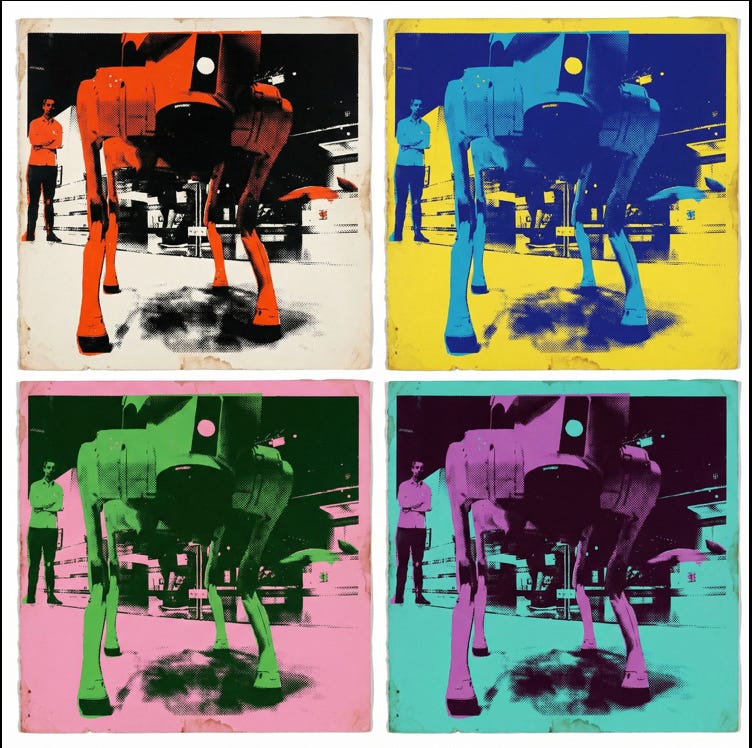
Just as we understand the world in purely our phenomenal constructs and are unable to perceive images purely in themselves, the robots are only able to articulate versions of the world as known through a conceptual filter. This manifests literally in the coloring and shaping of the image that appears noticeably different than the real world, and perhaps this is what Beeple means when he calls his work “a living conduit… a vast, ever-growing archive from which the future will be shaped” Perhaps this is what he means when he calls Regular Animals’ memory production “mechanical perception.”
If it is, then the allegory is already on the cusp of reality. A work of art that perceives us does so through lenses unknown, through categories not yet fully furnished, though concepts that may not always be our own. And if it can be illustrated, then it is closer than ever to being achieved. We may have an art that can, itself, create, and then what will we call those creations? What will we call them when we see they are unrecognizable to us? They will have to be the new phenomena.
Notes
Images of Regular Animals and their Memories come from Beetle Studio’s official website: https://regularanimals.ai/memory.html, and https://beeple-studios.xyz/beeple-exhibition/art-basel-miami/.